If your demand generation strategy still assumes buyers land on your site the same way they did two years ago, it’s time for a rethink. AI hasn’t just changed how buyers search. It’s changed how they decide, who they trust, and how far down the funnel they get before a human ever hears from them.
Key takeaways
- 94% of B2B buyers now use LLMs somewhere in their buying process, and around 25% are outsourcing parts of the decision entirely.
- Brand awareness spend is the first thing marketers cut and the thing GenAI visibility depends on most. Cutting it now creates a doom loop that’s hard to climb out of later.
- Mass-producing AI content for SEO and GEO reach is the fastest way to lose the traffic you just built. Quality is still the only lever that holds.
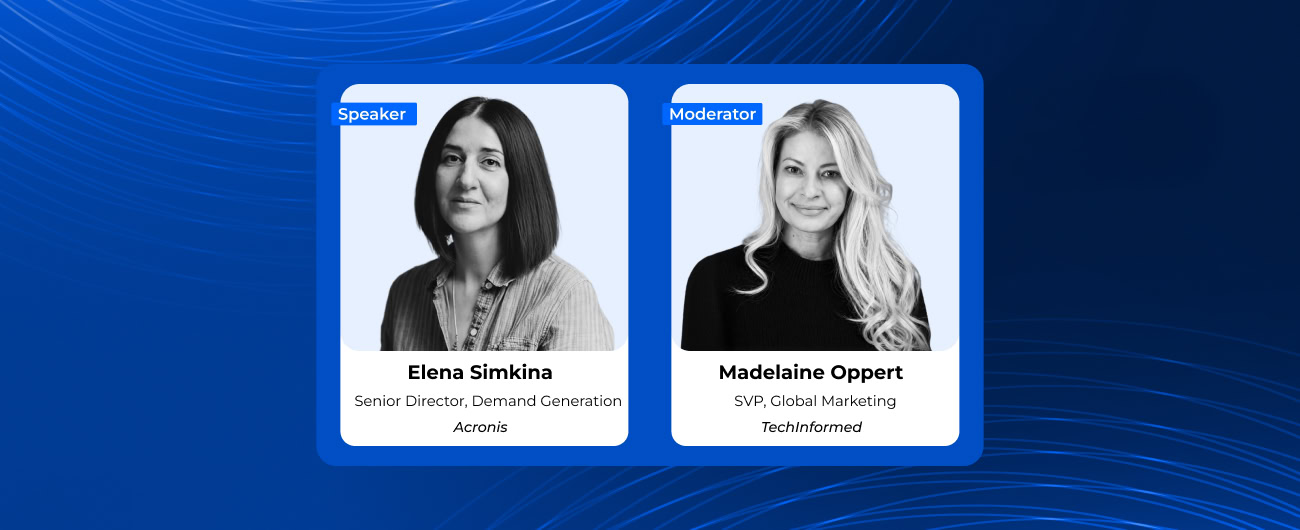
For our latest live discussion, Your Buyers Are Using AI. Is Your Demand Generation Strategy Ready?, host Madelaine Oppert, SVP of Global Marketing at TechInformed, sat down with Elena Simkina, who heads up Global Demand Generation at Acronis, to unpack exactly that shift.
Elena brings more than 15 years of experience building demand gen strategy across enterprise technology and cybersecurity, with a focus on AI-powered go-to-market, account-based marketing, and measurable revenue growth. What made the conversation land differently is that Elena sits on both sides of the table. She runs demand gen for Acronis, and she’s also the one evaluating and buying tools for her own team. That dual seat gave the discussion a rare, grounded view of how AI is reshaping the buyer journey from the inside and the outside at once, backed throughout by research and real numbers rather than guesswork.
It was a packed 40-minute session. If you’re rethinking your own demand gen strategy for the second half of the year, here’s what you need to know.
AI has changed how buyers research, evaluate, and shortlist vendors before your sales team ever hears from them. Watch how Acronis is adapting its demand gen strategy in response.
Buyers haven’t fully outsourced the decision. Not yet.
Elena shared that 94% of B2B buyers are using LLMs somewhere in their buying process. But only around 25% are outsourcing the decision itself for some of what they buy, not all of it. Buyers are using AI to move faster, not to hand over judgment entirely. Around 70% still want to talk to a rep before they commit.
Elena described watching this shift from both sides. As a buyer sourcing tools for her own team, her research process has condensed dramatically compared to two years ago.
“I had to talk to different peers. I had to read different forums. I had to read reviews before I even got to my shortlist. And now it’s one prompt in ChatGPT or Claude, and our buyers are the same. They don’t do all this extended research. They outsource it.”
That’s the shift marketers need to plan around. The extended research phase hasn’t disappeared. It’s been compressed into a single prompt, and if your brand isn’t part of what that prompt surfaces, you’re not on the shortlist at all.
The brand awareness “doom loop”
Perhaps the sharpest point of the whole session was Elena’s take on where marketing budgets are going wrong, and it’s not a new problem AI created. It’s an old one AI has made urgent.
“A lot of marketers actually are not able to fight for brand awareness budget. They get less brand awareness budget. They squeeze everything from the bottom funnel, and because there are no investments into brand awareness, bottom funnel stage is shrinking.”
Elena referenced a term she picked up at a recent Gartner conference: the brand doom loop. Awareness budget gets cut first because it’s the hardest to attribute directly to revenue. That squeezes the bottom of the funnel, which then justifies cutting awareness spend even further the next quarter.
The problem is that GenAI visibility depends on exactly the investment marketers keep deprioritizing. To show up in AI-generated answers, brands need a strong enough presence to be mentioned alongside competitors, recommended, discussed, and reviewed. Companies that kept investing in brand awareness through the quiet years are now seeing the payoff, sometimes without ever building a deliberate GEO strategy at all. And as you can safely assume, it’s mostly the big companies that have had the budget and teams to do this.
Madelaine pushed the point further, noting that any team cutting brand budget because they assume AI can now do the work for them has the logic backward. The GEO and AEO strategies everyone wants to build only work once the brand awareness is already there for AI to pick up on.
Quality over quantity, even with AI
What is the biggest mistake marketers are making with AI right now? Elena’s take: huge volumes of content simply because AI has made it cheap to do so.
She described a company in her industry that used AI to launch roughly 700 articles a month, chasing SEO and GEO visibility at a scale that would have been prohibitively expensive and almost impossible two years earlier. Traffic spiked immediately. Then Google made an algorithm change, and traffic dropped lower than it had been before the campaign started.
“Quality over quantity shouldn’t be changed, even with AI. AI gives us possibility to produce quality, and we just need to make sure we don’t forget about it.”
The same logic applies to video. Elena pointed to companies flooding channels with low-effort AI-generated video, noting that buyers notice, and it costs trust rather than building it.
Webinars hold up for the same reason. In a sea of AI-generated content, live conversation with a real person is one of the few things that still stands out.
“In the sea of sameness, in the sea of a lot of huge amount of information, possibility to listen to real people and to their opinion, how they present, will still be valuable.”
SEO isn’t dead, it’s just sharing the room with GEO
Does SEO still matter once buyers are getting answers straight from GenAI?
Elena’s answer was yes. About 70% of people who get an answer from GenAI still go back to Google afterward, either to double check the answer or to go directly to the vendor’s website and read the detail themselves. SEO isn’t being replaced by GEO. The two now sit side by side, with GEO thinking in topics rather than keywords.
There’s a trust dimension underneath this too. Buyers know GenAI results can be manipulated, whether through bot activity on platforms like Reddit or content designed purely to game visibility. That awareness is pushing people back toward sources that are harder to fake: peer conversation, reviews, webinars, and direct research on a vendor’s own site.
“We can’t rely only on one source. GenAI will not replace everything. People will still need some justification.”
No shared playbook yet, and that’s normal
When asked what metrics demand gen teams should track to know whether AI is helping or hurting buyer engagement, Elena was candid that the industry doesn’t have a settled answer yet. She referenced research suggesting around 80% of marketers feel they don’t have common ground on what the right KPIs even are, let alone how to measure them consistently.
Her team’s approach in the meantime: don’t throw out what already works. SEO rankings and organic traffic are still tracked alongside newer GEO signals. The tools and thinking are evolving in parallel rather than one replacing the other, and Elena expects the industry to land on a shared framework within a year or two rather than the decades it took for SEO to mature.
Watch it back
The full demand gen discussion is available on demand here. It’s 40 minutes and worth the time if AI is anywhere on your demand gen roadmap this year.
We run these live demand gen discussions regularly with senior practitioners working through the same shifts as your team. If you want to catch the next one, join us on the 21st of July.