
AI search has rewritten the buyer journey
Discovery happens before your website
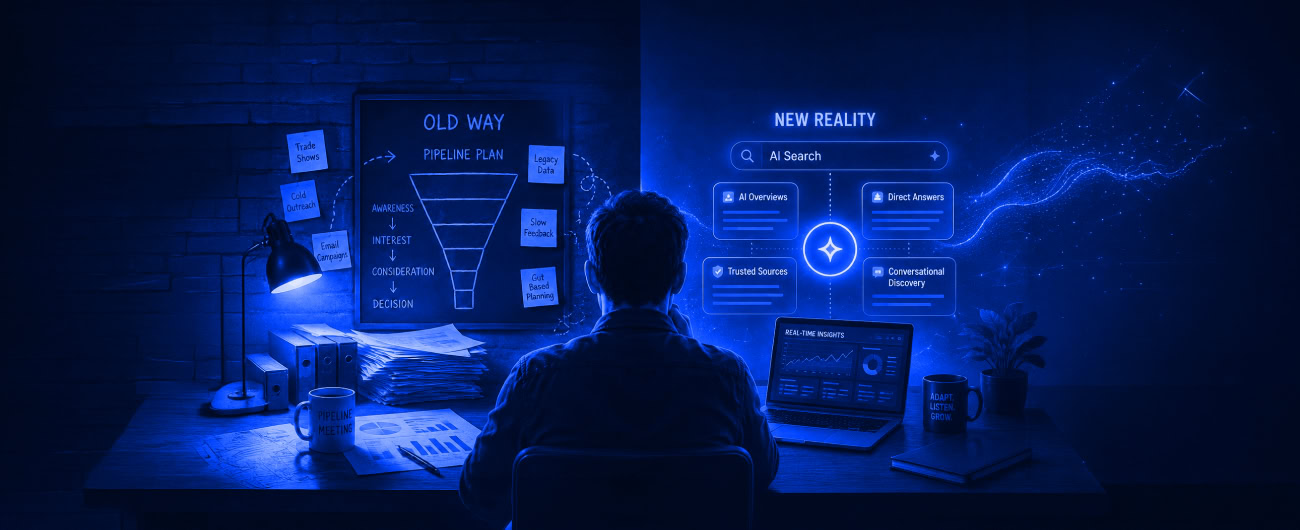
B2B buyers are not starting their research on your website. They are asking ChatGPT for vendor shortlists, using Perplexity to compare options, and checking what peers recommend in LinkedIn threads and private Slack channels. By the time a buyer visits your site, they have often already decided whether you are worth talking to.
This is not a fringe behavior. It is how a growing proportion of technology purchase research happens in 2026. The consideration set – the shortlist of vendors a buyer is willing to evaluate, is being shaped before any trackable digital interaction occurs. If your brand is not present in the channels where that shortlist forms, you are not being considered, and your campaign metrics will not tell you why.
The LinkedIn B2B Institute’s research on AI search and buyability suggests that the question is no longer just whether buyers can find you. It is whether AI systems and peer networks position you as worth considering before the buyer actively searches. Discoverability and buyability are not the same thing, and optimizing for one does not guarantee the other.
Zero-click behavior only makes the problem worse. A buyer gets an AI-generated answer, forms a view, and moves on. Your analytics register nothing. Your CRM has no record. Your dashboard looks fine. The pipeline consequence shows up weeks or months later when a campaign that looked healthy on paper produces fewer qualified conversations than expected.
AI didn’t fix the funnel. It made more of it invisible.
The dark funnel is growing
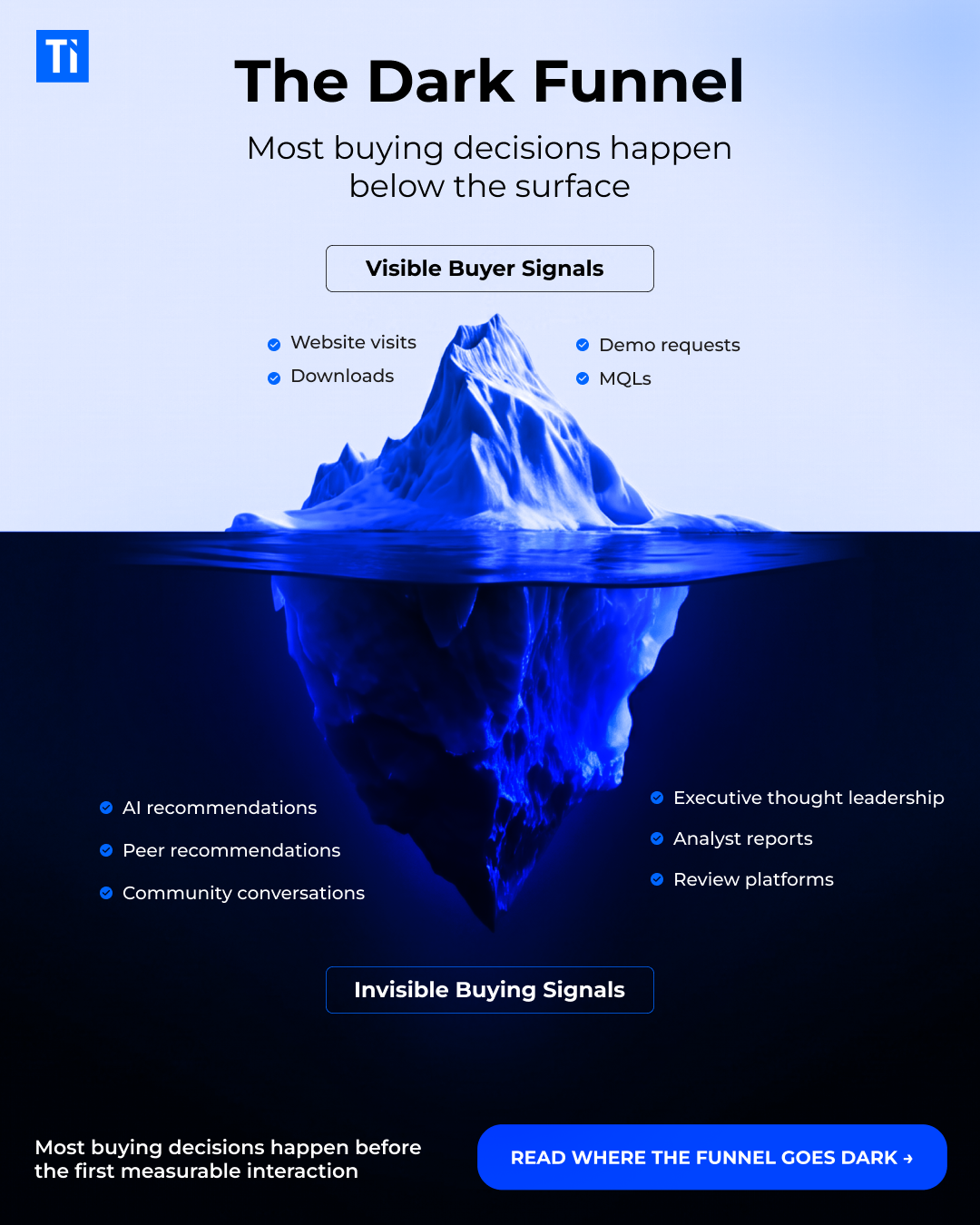
The dark funnel has always existed. Peer recommendations, executive conversations, word of mouth at industry events, the list goes on. AI search in B2B marketing has expanded it significantly and accelerated how fast it shapes purchasing decisions.
Buyers are now researching through AI chat which leaves no data trail, in private communities your marketing team cannot access, and through personal networks that no attribution model can capture. Buyers are doing the research, forming preferences, and making decisions. Most of it happens somewhere marketing cannot track.
By the time a lead fills out a form or books a demo, a meaningful portion of their decision has already been shaped in places you were not measuring. The form fill is not the start of the buying journey. For many buyers, it is close to the end of it.
Gartner’s 2026 research on trust in the AI era is direct on this point: as AI transforms how people discover and evaluate vendors, trust has become the scarce resource, not attention. Consumer trust in big brands has dropped from 70% to 60% since 2021. In an environment where AI surfaces options and peer networks validate them, editorial credibility, expert proof, and community advocacy carry more weight than paid reach or website traffic volume.
The implication for pipeline planning is significant. If trust is being built in channels you cannot measure, planning entirely around the channels you can measure will consistently underestimate what pipeline requires. The campaign looks underfunded. The leads look low quality. The real issue is that the planning model is not accounting for where the buying journey begins.
AI search is not the problem. Campaign planning just has not caught up yet.
We’re forecasting using yesterday’s signals
Most B2B campaign planning follows the same process it has followed for years…
- Pull website traffic data.
- Look at historical click-through rates.
- Set a cost-per-lead target based on industry benchmarks.
- Build a campaign that optimizes for MQL volume.
- Report results against those inputs at the end of the quarter.
None of that adequately reflects how the AI-first B2B buyer journey works today.
Website traffic undercounts the buyers who researched through AI interfaces and never visited your site. Click-through rates miss the zero-click research that shaped the shortlist before any click happened. Cost-per-lead benchmarks sourced from industry reports reflect averages across markets, categories, and buyer profiles that may have very little to do with your ICP, your region, or your deal size. MQL volume counts a signal of interest, not a signal of purchase intent.
Gartner’s June 2026 survey of 426 senior marketing leaders found that 84% of companies are stuck in a brand doom loop, underinvesting in brand measurement, lacking confidence in the results, and attracting even less funding as a consequence. That loop gets significantly worse when the metrics used to justify investment are not connected to the outcomes that drive revenue growth.
The signals most campaign plans rely on traffic, clicks, MQLs, only capture part of what is happening. As more of the AI search B2B marketing journey moves into channels that those signals cannot see, the plan becomes less reliable. More budget pointed at the same places produces the same blind spots.
A better way to plan pipeline in an AI-first world
A planning framework for 2026
Start with what you need to achieve, not how you plan to get there. A revenue goal is a more useful brief than a channel budget.
What pipeline does this campaign need to deliver? What deal size, what conversion rate, and what volume of qualified contacts does that imply? Working backwards from those numbers produces an entirely different brief than working forwards from an impression target or a CPL estimate.
From there, the planning accounts for buying signals that cannot always be tracked directly. That means designing for presence in editorial publications, peer platforms, and trusted industry environments, not just the channels that show up cleanly in an attribution report. It means treating brand and content investment in the right environments as pipeline investment, not a separate awareness exercise. The 95/5 rule suggest that around 95% of your potential market is not actively buying at any given moment, but they are forming views about which vendors are worth considering when they are ready. AI search in B2B marketing has made those pre-buying interactions more influential, not less.
First-party campaign data replaces generic benchmarks wherever possible. What have campaigns against similar audiences, in similar markets, with similar deal sizes, delivered? That is a more reliable input than any published industry average, and it produces forecasts that reflect reality rather than assumption.
Finally, alignment with sales happens before launch, not after the first leads arrive. As partners, you need to agree on what counts as qualified? What follow-up process is in place? What engagement context will each lead carry when it is passed across? These are planning decisions, not post-campaign conversations.
None of this requires new technology, just a different starting point.
Better planning starts before the campaign launches
The gap between what buyers do and what marketing can measure has grown, and it is not going to shrink on its own. Closing it means starting from revenue goals, buyer behavior, and historical performance rather than from what a platform dashboard can easily surface.
TiForecast is built on that starting point. Using three years of campaign performance data from programs delivered across 21 countries and informed by engagement with 131M+ verified B2B technology decision-makers, it generates an indicative campaign plan and pipeline forecast from three inputs: lead generation goal, target market, and average contract value. The projections are grounded in first-party campaign history rather than generic benchmarks, which makes them a more reliable planning tool for the environment B2B marketing leaders are operating in now. It is free and you receive a result in 15 seconds.
The buyer journey has moved on. Has your planning?
AI search in B2B marketing changed the buying journey. The buyers who matter are researching through AI interfaces, peer communities, and editorial platforms that traditional campaign metrics were not designed to see. Campaign planning that does not account for that will keep underestimating what predictable pipeline requires.
The planning model needs to catch up with the buyer journey. Starting with revenue goals, first-party data, and the right channel mix is where that starts.